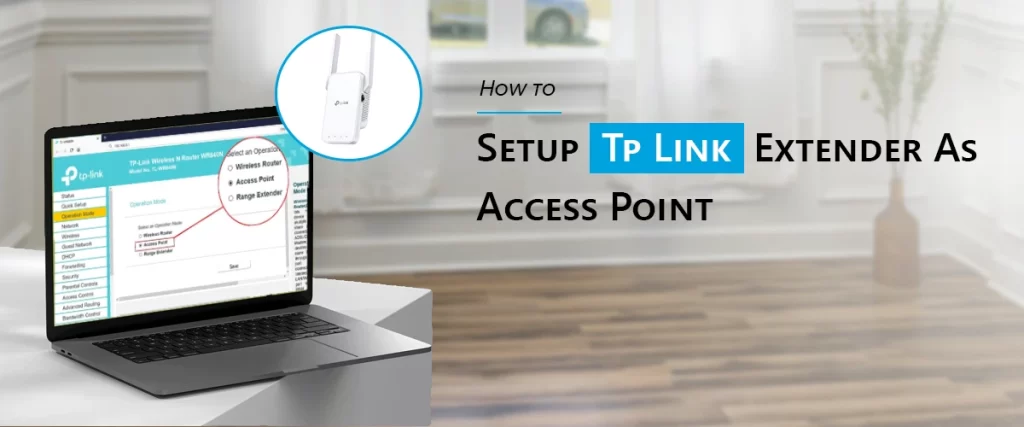
To set up a TP-Link extender as an access point, connect it to your router via Ethernet, open tplinkrepeater.net in a browser, log in, and select Access Point Mode from the mode options. Configure your WiFi name and password, then save. Setup takes approximately 5–10 minutes.
TP-Link provides adaptable networking devices that may function as wired access points or wireless extenders to increase Wi-Fi coverage. Because it provides faster speeds, less interference, and more reliable connectivity than regular extender mode, many customers like the TP-Link extender access point mode.
Everything you need to know is covered in this article, including the advantages of Access Point mode, how to set it up precisely, and how to troubleshoot if your extender keeps disconnecting.
What Is TP-Link Extender Access Point Mode?TP-Link extenders usually function in two ways:
- Repeater/Range Extender Mode: This mode wirelessly extends current Wi-Fi, however it may use less bandwidth.
- Access Point (AP) Mode: This creates a new, reliable Wi-Fi hotspot by connecting an Ethernet wire from your router to the extender.
AP Mode is best if
- You want to be as stable and constant as possible.
- There are dead zones in your house that are distant from the router.
- An Ethernet wire can be run to a different room.
The performance of your network can be significantly enhanced by switching to Access Point mode if you have already completed a basic TP link extender setup.
Benefits of Using TP Link Extender as Access Point
Here are some reasons to think about AP mode before you start:
- Better Stability: Wired Ethernet backhaul eliminates the 50% speed loss typical of wireless repeater mode
- Faster Speeds: AP mode delivers your router’s full bandwidth — for example, a 500 Mbps plan delivers close to 500 Mbps at the extender, vs. ~250 Mbps in repeater mode
- Ideal Coverage: A single extender in AP mode can reliably cover an additional 1,000–2,000 sq ft depending on the model
- Lower Latency: Wired backhaul reduces latency by 10–30ms compared to wireless repeater mode — critical for gaming and video calls
- Fewer Drops: Eliminates wireless interference between router and extender that causes disconnections in repeater mode
What You’ll Need Before Setup TP Link extender as access point
Make sure you have the following in order to effectively configure your TP-Link extender Access Point mode:
- An appropriate TP-Link extender (such as RE200, RE315, RE450, RE650, etc.)
- An Ethernet cable, which is often provided with the package
- Your router turned on and established an internet connection.
- A tablet, laptop, or smartphone for setup
Once everything is prepared, proceed as directed below.
Simple Steps for setup TP Link extender as access point
1. Use an Ethernet to connect your extender to the router.
Plug your TP-Link extender into a power outlet near your router.
Using an Ethernet cable:
- Attach one end to your router’s LAN port.
- Attach the other end to the TP-Link extender’s Ethernet port.
- TP-Link extender access point mode is made possible by this connected connection.
2. Turn the Extender on
- Let the extender start up. The majority of models take about 30 seconds.
- After starting to flicker, the LED lights ought to steady.
3. Establish a Wi-Fi connection with the Extender
- Look for the default Wi-Fi name of the extender on your laptop or smartphone.
- Connect to it; a password is not required for initial setup.
4. Go to the TP-Link Configuration Page.
After connecting, use a web browser and go to:
- Either http://tplinkrepeater.net or
- 192.168.0.254
- A new admin password creation prompt will appear. This is not for Wi-Fi; it is purely for device login.
5. Choose the mode of TP-Link extender access point
Following your login:
- There will be several modes available.
- Select the mode of access point.
- Next, click.
- At this point, your extender will change modes.
6. Establish a New Wireless Network
Your Access Point Wi-Fi may now be configured:
- Wi-Fi name: Select a distinctive name, such as “Home_AP.”
- Create a secure password.
- Security: Select WPA2-PSK or WPA3-Personal if available — WPA3 is the most secure option and supported on newer models like the RE505X and RE650.
- Click “Save.”
7. Position the Extender Where You Want It
Once everything is set up, disconnect your extender and position it:
- In the space you wish to improve Wi-Fi
- next to an electrical outlet
- With the router’s Ethernet wire attached
- The AP mode Wi-Fi will start broadcasting as soon as it is turned on.
Troubleshooting Advice
Try these solutions if something goes wrong during setup:
1. Is Access Point Mode Not Displayed by the Extender?
- Firmware upgrades are necessary for some models. After logging in, search the options for Firmware Upgrade.
2. The tp link extender keeps disconnecting
- This problem is typically resolved by switching to AP mode since wired backhaul is more reliable than wireless.
Additionally, make sure:
- The Ethernet wire is undamaged.
- The router’s LAN port is operational
3. Unable to reach tplinkrepeater.net
- Try using the IP address 192.168.0.254.
- Alternatively, try again after resetting the extender.
Final thoughts
One of the greatest methods to improve the performance of your home or business Wi-Fi is to set up a TP-Link extender access point. Access Point mode provides you with steady speed, stability, and seamless connectivity across your area rather than depending on wireless connections that could deteriorate with distance.
If you experience any issues not covered in this guide, visit tp-link.com/support, enter your extender model number, and access the official setup documentation and firmware downloads for your specific device.
FAQs
Can TP-Link extender Access Point mode improve Wi-Fi speed?
Indeed. Compared to wireless repeater mode, access point mode employs a connected Ethernet connection, which eliminates signal loss and increases overall speed, stability, and bandwidth—especially in big households.
Do I need two separate networks in Access Point mode?
Not always. You can either reuse your primary SSID or create a separate WiFi network. While distinct names aid in identifying coverage regions, using the same name enables smooth roaming.
Does TP-Link Access Point mode support mesh networks?
Mesh-like roaming is made possible by some TP-Link extenders that enable OneMesh, but only in conjunction with a suitable router. A full mesh system cannot be created using only Standard Access Point mode.
Is TP-Link Access Point mode suitable for gaming?
AP mode is perfect for online gaming, streaming, and other real-time, high-bandwidth activities since it uses a wired backhaul to deliver reduced latency, greater stability, and higher throughput.